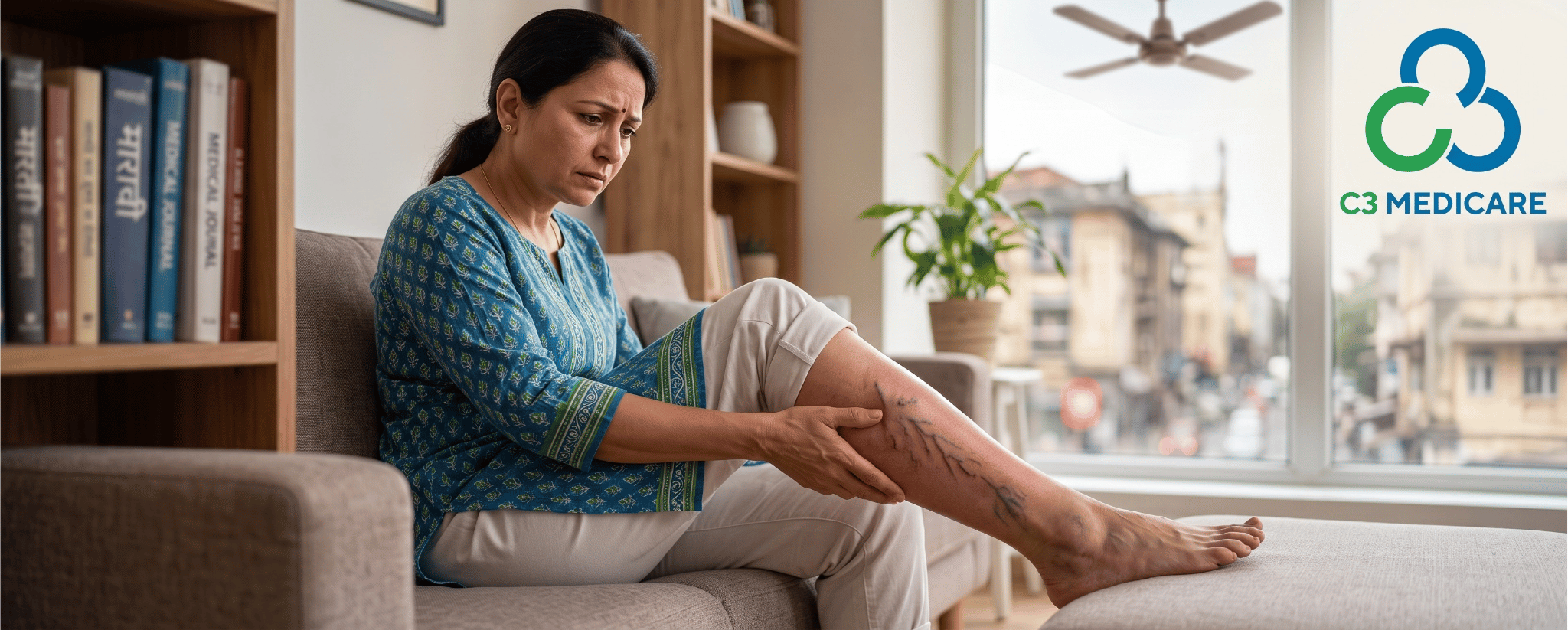
Pain or swelling in the leg is something many people experience from time to time. After standing for long hours, travelling for several hours, or having an unusually active day, your legs may feel heavy and tired. Hence, it is easy to assume that every swollen or painful leg simply needs some rest.
However, what if the swelling appears mainly in one leg? What if the leg suddenly becomes painful, warm or tender? These symptoms can sometimes indicate deep vein thrombosis (DVT), a condition in which a blood clot develops in a deep vein, most commonly in the leg.
DVT needs timely medical attention because part of the clot can break away and travel to the lungs, causing a potentially life-threatening pulmonary embolism. At the same time, varicose veins and chronic venous disease can also produce leg swelling, heaviness, and discomfort. Hence, understanding the difference between common vein-related symptoms and possible DVT warning signs is extremely important.
What Exactly Is Deep Vein Thrombosis?
Deep veins carry blood from the legs back towards the heart. When a blood clot forms inside one of these veins, the condition is called deep vein thrombosis.
DVT commonly affects veins in the lower leg, thigh, or pelvis. Some people have very noticeable symptoms, while others can develop DVT with few or even no symptoms.
Common DVT symptoms in the leg include new swelling, pain or tenderness, warmth, and sometimes a change in skin colour. These symptoms frequently affect one leg, although symptoms alone cannot confirm whether a blood clot is present.
If DVT is suspected, medical assessment and appropriate testing are required.
What Does a Blood Clot in the Leg Feel Like?
One of the difficulties with DVT is that its symptoms can resemble a muscle injury or other leg problems. Hence, knowing the possible blood clot in leg symptoms can help you recognise when a problem requires medical evaluation.
Possible warning signs include:
- New swelling, particularly when one leg is more swollen than the other
- Pain or tenderness in the calf or thigh
- Warmth in the affected area
- Redness or other skin discolouration
- Unexplained leg discomfort without an obvious injury
However, DVT cannot be diagnosed simply by looking at the leg. Depending on the clinical assessment, a doctor may recommend a D-dimer blood test and/or compression ultrasound to investigate suspected DVT.
Is Swelling of the Legs Dangerous?
Should you be immediately concerned about DVT if your ankles are slightly swollen after you have been standing all day? Not necessarily.
Whether the swelling of the legs is dangerous or not depends on the cause, the rate at which it has developed, and whether there are other symptoms. Both legs may swell due to chronic venous issues and a number of other health conditions. On the other hand, sudden swelling of one leg that cannot be explained, and particularly painful, warm, or tender, requires urgent medical attention to exclude DVT.
When the symptoms of the legs are accompanied by sudden shortness of breath, chest pain, coughing up blood, fainting or a very rapid heartbeat, emergency medical attention is needed, as it may be the symptoms of pulmonary embolism.
Do Varicose Veins also cause swelling of the legs?
Yes. The swelling of the legs can be caused by varicose veins and chronic venous insufficiency since the valves in the leg veins are not working well. Blood can pool in the lower limbs instead of travelling efficiently back towards the heart.
This may result in aching, heaviness, swelling of the ankle, itching, and enlarged veins. The symptoms can be more pronounced following long periods of standing and can be alleviated by raising the legs.
The key is that swelling does not necessarily have to be attributed to visible varicose veins. Acute, unilateral swelling requires evaluation since DVT and other diseases may cause similar symptoms.
DVT and Varicose Veins are not synonymous.
DVT is associated with the deep veins, and the visible twisted veins commonly known as varicose veins are associated with the superficial veins.
Then, does that mean you have DVT because you have varicose veins? No.
However, varicose veins are associated with increased risk of venous thromboembolism in observational studies, and superficial veins can be the cause of thrombosis themselves. Thus, the change of a symptom cannot be ignored simply because a person knows that he or she has varicose veins.
Understanding the Progression of Varicose Vein Disease
People often search for varicose veins stages, but medically, chronic venous disease is commonly classified using the CEAP system rather than a simple stage 1-to-4 scale.
Here is an easy way to understand the clinical progression:
| Clinical finding | What may be noticed |
| C0–C1 | No visible veins or small spider/reticular veins |
| C2 | Varicose veins |
| C3 | Leg or ankle swelling |
| C4 | Skin changes related to chronic venous disease |
| C5 | Healed venous ulcer |
| C6 | Active venous ulcer |
Not every patient progresses through each category. However, persistent swelling, skin changes or ulceration can indicate more advanced chronic venous disease and deserve medical evaluation.
What Are the Early Signs of Varicose Veins?
Visible bulging veins are easy to recognise, but early-stage varicose veins symptoms may be more subtle.
Some people experience aching, heaviness, throbbing, itching, cramps, or tired legs. Small visible veins may appear, and symptoms can worsen after standing or sitting for prolonged periods.
This is a good time to seek assessment rather than waiting for severe skin changes or ulcers to develop. Early evaluation can establish whether venous reflux is present and whether treatment is necessary.
Why Do Varicose Veins Develop?
To understand varicose vein causes and treatment, it helps to first understand what happens inside the veins.
Leg veins contain valves that help blood move towards the heart. When these valves become incompetent, blood can flow backwards and pool inside superficial veins. Increased venous pressure can then cause the veins to enlarge and become tortuous.
Age, family history, pregnancy, prolonged standing, and obesity are among the factors associated with varicose veins. Treatment depends on symptoms, ultrasound findings, and severity rather than appearance alone.
How Doctors Tell DVT and Varicose Vein Problems Apart
A physical examination can provide useful clues, but symptoms alone are not reliable enough to rule DVT in or out.
For suspected DVT, clinicians generally assess the patient’s symptoms and risk factors and may use a validated clinical probability score. D-dimer testing and compression ultrasound are then used when appropriate.
For varicose veins, duplex ultrasound can show how blood is moving through the veins and identify reflux or obstruction. This information is particularly useful when planning treatment.
Hence, ultrasound has an important role, but the exact test and urgency depend on the condition being investigated.
Who Has a Higher Risk of Developing DVT?
A blood clot can be formed because of interference with normal blood flow, the predisposition of blood to clotting, or the damage of a blood vessel. Prolonged immobility, recent major surgery, major injury, active cancer, previous DVT, pregnancy and the postpartum period, and some medications or medical conditions can increase risk.
Long travel can also be a risk factor, particularly when there are other risk factors.
Thus, in case of risk factors and the appearance of unexplained one-sided swelling or pain, it is even more crucial to consult a doctor as soon as possible.
What Will Happen in case DVT is confirmed?
The treatment is based on the location and size of the clot, symptoms, risk of bleeding, and the overall health of the patient. Anticoagulant medications are the main treatment for the majority of patients and help to prevent the development of the already existing clot and reduce the risk of additional clots.
In some patients with more widespread DVT, especially some clots in the larger veins of the thigh or pelvis, experts might contemplate catheter-based procedures. These procedures are not obligatory for every DVT patient and should be selected according to certain clinical circumstances.
What is the treatment of Varicose Veins?
Varicose veins are also treated in a personalised manner. In some patients, lifestyle measures and compression can be used to control symptoms, although in cases where there is a large vein reflux, the abnormal vein causing the issue can be treated with minimally invasive procedures.
Depending on the anatomy and clinical presentation, treatment may include endovenous procedures or other image-guided procedures. This is why it may not be the complete solution to treat the visible vein without understanding the underlying venous circulation.
Do Not Ignore a Sudden Change in Your Leg
The biggest takeaway is simple: not every painful or swollen leg is DVT, but DVT cannot safely be diagnosed or excluded at home.
Long-standing heaviness and swelling associated with varicose veins deserve proper evaluation. However, sudden swelling of one leg, particularly when associated with pain, tenderness, warmth or colour change, requires prompt medical assessment. Chest pain or sudden difficulty breathing alongside possible DVT symptoms requires emergency medical attention.
C3 Medicare provides Interventional Radiology services and minimally invasive treatment for conditions including varicose veins. Patients with persistent varicose vein symptoms can undergo specialist evaluation to understand the underlying venous problem and discuss suitable treatment options. Where symptoms raise concern about a more serious vascular condition, timely medical assessment can help determine the appropriate next step.
If visible veins, persistent leg swelling, heaviness or discomfort are affecting your everyday life, contact C3 Medicare for an appointment and find out which treatment approach may be appropriate for your condition.
This article is intended for general informational purposes and does not replace personalised medical advice, diagnosis or emergency medical care.